Your app works.
It just isn't shipped.
The last mile kills most projects: the database with no authorization, payments with unverified webhooks, secrets still in git, nothing deployed. Wanju finds what's actually between you and a paying user, then closes it — in any repo, whatever built it.
Your first Finish Pass is on us · All Finish sessions are free during beta · Agents use your own AI key · See pricing
The real product
One local folder.
A useful map immediately.
This is the actual Wanju dashboard analyzing a local sample clone of Wanju itself. It uses the heuristic scan: no GitHub account and no AI key.
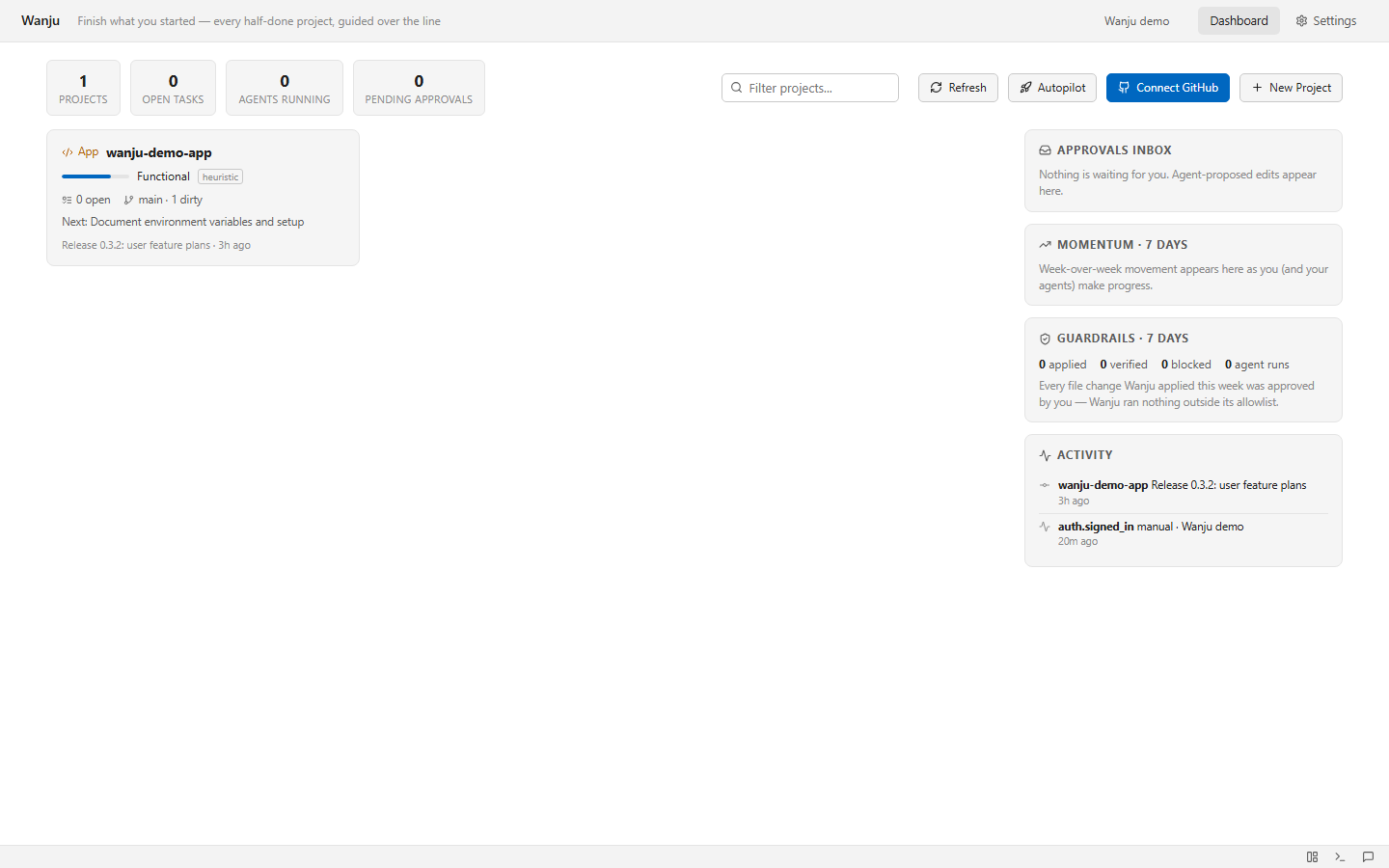
wanju-demo-app · not a rendered mockEvery developer has a folder
they're afraid to open.
You don't lack ideas or ability — you lack a way back in. Six months later you can't remember what state a project is in or where to start, so you start something new instead. Wanju opens the folder for you: it reads each repo, tells you where it really stands, and hands you the one next step. See how the loop works →
What finishing looks like.
Approvals inbox + phone
Built-in agents propose. You approve. From anywhere.
Every edit the built-in agent wants to make waits as a diff in one inbox, across all your projects. Nothing touches disk until you say yes, and applied changes can be reverted.
Away from your desk? Create a time-limited link and approve from your phone — payloads are end-to-end encrypted, and the relay never holds the key.
Autopilot
Point it at the backlog, set a budget, walk away.
Autopilot works through unblocked tasks across the projects you select, inside a task and token budget you set. It stops when the budget runs out — and every single change still queues for your approval.
Token intelligence
Spends your tokens like it's paying for them.
Agents read your codebase the smart way: the few most relevant files in full, the rest as compact signature outlines — 57% fewer context tokens per request on average, measured across four real repositories. Requests keep a stable prefix, so your provider's prompt cache serves the repeated part at its discounted rate.
Set a personal 5-hour and weekly token budget per provider and Wanju shows exactly what's left, combined across providers. If one runs out of credits mid-session, work continues on another provider with a model of the same capability tier — the session never dies, and code quality stays consistent.
Verify & push
Done means your tests said so.
After you approve a change, your test suite runs automatically and the result is attached to the run. A live preview gets health-checked too. Approved work pushes to a protected wanju/ branch with a one-click pull request — your main branch stays exactly as it was.
Momentum
Watch the graveyard shrink.
The dashboard tracks readiness week over week, tasks closed, and your streak. Beside it, a plain-language summary of what agents applied, what your tests verified, and what the guardrails blocked — backed by the audit log, not by trust.
wanju /wahn-joo/ · noun, Korean
Completing the entire course — the word for crossing a marathon's finish line, not just entering the race. Halfway is where most projects die; this product is named for the other half.
Deny by default.
Wanju's tools are deny-by-default per project, and agent edits wait for your approval. Details in the docs.
Your features, not just the plan
Describe a feature or paste your own implementation plan and the AI sizes it honestly — a tiny tweak stays one task, a real migration becomes an ordered list — then turns it into reviewable tasks on the board.
Markdown tasks agents share
Tasks are plain .md files in each repo. Humans, the app, and any agent edit the same files; the board reconciles live.
Honest analysis
Stages are evidence-backed, never invented percentages. The deep AI assessment cites files for every claim.
Fast GitHub imports
Blobless partial clones, three at a time, with live progress — 80–95% less download, even for huge repos.
Local-first by construction
Repos and keys stay on your machine. API keys are encrypted with your OS keychain and sent only to your provider.
Your provider, your key
The built-in agent works with your own OpenAI, Anthropic, or Gemini key.
Cross-device sync
A private manifest repo syncs your workspace between machines; every clone and update is individually approved.
Keys verified, models real
Saved API keys are tested against the provider instantly — the model list you pick from is the one your account can actually use.
Tokens left, at a glance
Personal 5-hour and weekly budgets per provider, remaining tokens combined across all of them, cache savings shown honestly.